The Authentic Orthography
Ἑρμῆς Hermēs
Messenger of the Gods · Psychopomp · Lord of Thieves
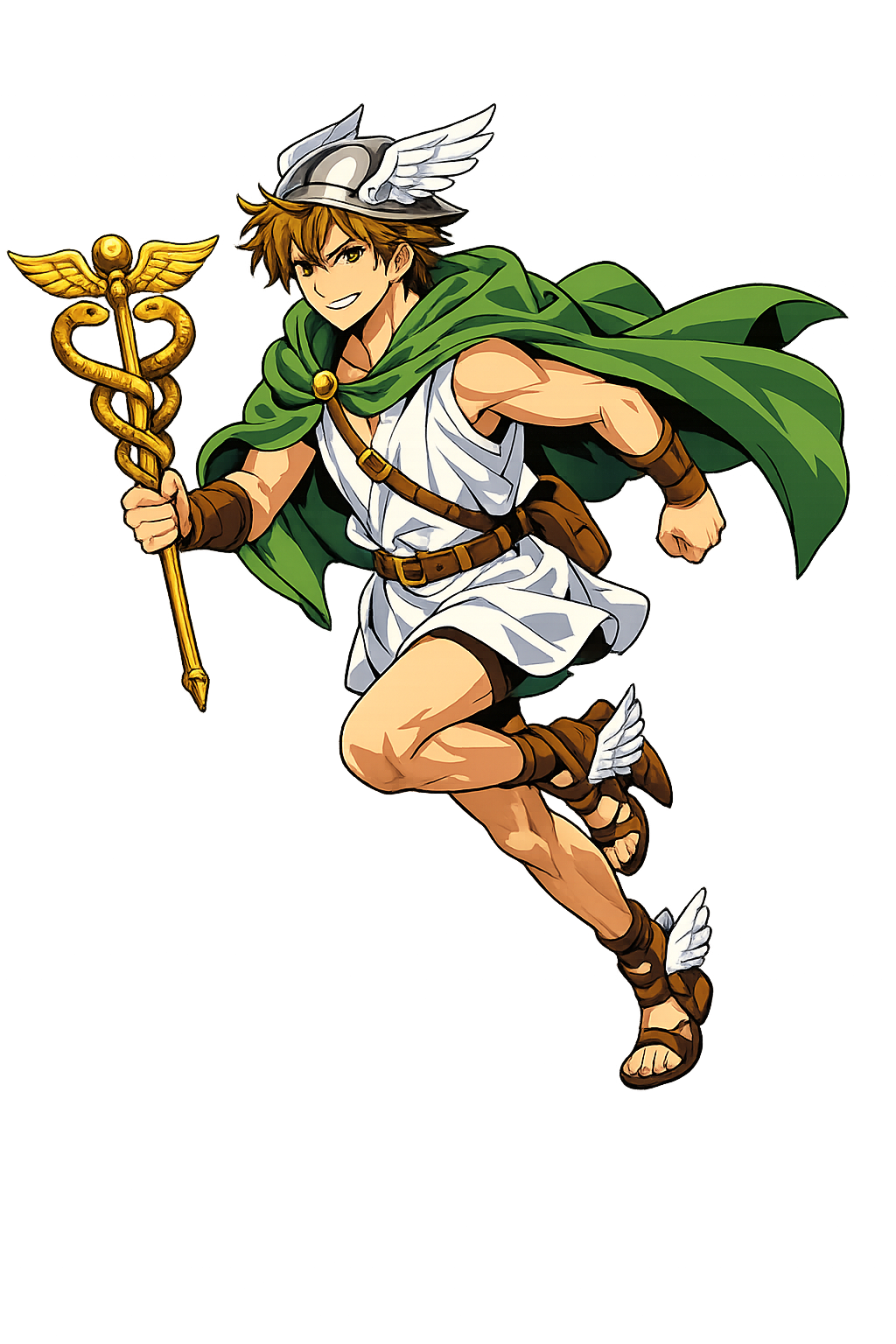
The Authentic Orthography
Messenger of the Gods · Psychopomp · Lord of Thieves
Why hermēs.com is the correct form
Ἑρμῆς
The name in its original Greek form. The rough breathing on the epsilon, the long ēta carrying the stress. A name spoken in whispers by merchants, in oaths by thieves, in prayers by travelers at crossroads. He is the god who moves between all worlds.
HERMES
Reduced to a luxury brand. A delivery service. A fashion house. The god who invented the lyre, stole the sun god's cattle on his first day of life, and guides the dead to the underworld — reduced to a label on a handbag. The macron is not decoration. It is distance. It is the space between worlds.
hermēs
The macron on ē restores the long vowel. The Greek Ἑρμῆς carries an acute on the η, which is also long — stress and length fused into a single mark. Because the original has both features, hermēs is Tier‑1: the full scholarly orthography. The macron is the wing. The name is the flight.
hermēs.com → xn--herms-6ya.com
The non-ASCII character ē (U+0113) is encoded while the ASCII remains visible. To the DNS, it is Punycode. To humanity, it is Hermēs.
How the Messenger was truly spoken
Domains, symbols, and the art of crossing boundaries
Hermēs is not the god of roads. He is the god of crossing. He moves between Olympus and earth, earth and underworld, waking and dreaming, commerce and theft. He is the only god who is welcome everywhere — because he is the only god who threatens no one. He does not rule. He connects. He does not conquer. He delivers.
The official herald of Olympus — but also the god of unofficial messages. Secrets, whispers, coded signals, the note passed under the table. He invented writing so that words could travel farther than voices.
The guide of souls. When you die, it is Hermēs who meets you at the boundary. Not Hádēs — Hádēs waits at the throne. Hermēs walks with you. He is the god of the last journey, the final road, the crossing no one makes alone.
He protects merchants and blesses thieves with equal enthusiasm. The marketplace and the dark alley are the same to him — both are transactions. He invented weights and measures, then taught mortals how to cheat with them. He is honest about his dishonesty.
The herm — stone pillars at crossroads bearing his face — marked the boundary between territories, between known and unknown. He also governs dreams, the boundary between waking and sleep. Every threshold is his temple. Every crossing is his prayer.
Stories of speed, cunning, and divine mischief
Born at dawn in a cave on Mount Kyllēnē. By noon he had invented the lyre from a tortoise shell. By dusk he had stolen fifty of Apollōn's sacred cattle, reversed their hooves to confuse the tracks, and hidden them in a cave. When accused, he played the lyre — the first music ever made. Apollōn wept. He traded the cattle for the instrument. On his first day of life, Hermēs had invented music, committed theft, and negotiated a peace treaty with a god. He was not precocious. He was complete.
Hēra set the hundred-eyed giant Argus to guard Io, the maiden Zeús had transformed into a cow. No one could approach — Argus never slept with all his eyes at once. Hermēs descended, disguised as a shepherd, and began to tell stories. He played the pipe. He spoke of the stars, the gods, the origin of the lyre. One by one, Argus's eyes closed. When the last eye shut, Hermēs drew his sword and severed the giant's head. Hēra placed Argus's eyes on the peacock's tail. This is the Hermēs method: win without fighting, kill without warning, turn your enemy's corpse into ornament.
When mortals die, it is Hermēs who leads them to the Styx. Not Hádēs — Hádēs judges. Not Kharōn — Kharōn ferries. Hermēs walks with you. He explains what is happening. He answers questions. He is the only god who treats the dead as guests rather than subjects. Orpheus followed him into the underworld. Persephone was returned by his guidance. He moves between life and death as easily as between waking and dream — because to Hermēs, every boundary is a door.
Hermēs invented fire. He invented boxing. He invented gymnastics, astronomy, weights and measures, and the alphabet. He gave humanity the tools to compete, to count, to communicate, to navigate. Why? Because every invention is a message. Fire says: you need not fear the dark. The alphabet says: your voice can outlive you. Astronomy says: the gods have patterns you can learn. Hermēs does not give gifts. He gives languages.
Zeús commands. Apollōn illuminates. Árēs destroys. But Hermēs connects. He is the only god who speaks to all the others without fear. He carries messages between enemies. He guides the dead past the lord of the dead himself. He moves through every realm, every hierarchy, every boundary — and is welcomed in all of them.
This is not a directory. This is a resurrection.
Enter the Codex
See how Hermēs behaves in the PUNYCODEX Type Tool — with predictive autocomplete, character-by-character breakdown, and scholarly constraint validation.
hermes
→
Hermēs
The many faces of Hermês across scripts and conventions.
Our active domain. The circumflex ê captures both stress and length of Greek Ἑρμῆς in a single character.
hermês.comStandard academic convention. Preserves length but not stress position. Redirects to Hermês.
hermēs.comModern English form.
hermes.com (taken)